




 How to VoteFalcons vote!
- Admissions
- Tour
- MapGift of Class of 2012
- Hours of Operation
- Shuttles
- Athletics
- Athletics TicketsPurplepass
- Blackboard
- Seats Lists
- College Scheduler
- MyFalconSSB for Students
- FacultySSBSSB for Faculty
- Library
- Emergency
- Falcons Care CenterConcernCenter
- Technology Help Desk Chat
- Technology Systems Status
- Directory
- Indoor Maps
- News
- Video
- Calendar
- Catalog
- Alumni
- Give
- University Website
- Athletics Website
- Dining Website
- Bookstore Website
- Gear Shop Website
- About










Latest News
- University celebrates Italian American Heritage Month with food and live musicFitchburg State University’s Center for Italian Culture invites the campus community and the general public to celebrate Italian American Heritage Month with an unforgettable evening of music and culinary traditions on Saturday, Oct. 24, in the Falcon Pub in Hammond Hall, 160 Pearl St. Doors open at 5 p.m. with the performance beginning at 7 p.m. The special celebration features smooth-voiced entertainer Jimmy Mazz, a seasoned performer with more than 40 years of experience headlining at premier venues across the country, including the Superstar Theater in Atlantic City. Mazz will bring his dynamic stage presence to campus for a live musical tribute highlighting iconic classics made famous by beloved Italian American artists across generations. Tickets for the event are $50 per person, which includes full access to the performance and catering. Due to venue capacity, seating is strictly limited, and advance registration is strongly encouraged. Guests can reserve their seats today through the university’s online payment portal. For more information go to fitchburgstate.edu/cic In addition to live entertainment, guests will enjoy a curated menu of traditional cicchetti — authentic Italian-style appetizers — specially catered by Fitchburg State’s Dining Services. The event is open to students, faculty, staff, alumni, and local community members. A variety of fine Italian wines and beers will be available for purchase at the Falcon Pub bar for attendees who are 21 and older with valid identification.
- Instrumental and choral ensembles perform Music Mega Mix on Oct. 20The Music Mega-Mix, Fitchburg State University’s showcase of bite-sized performances by its Community Orchestra, Concert Band, Chamber Choir, Concert Choir, Falcon Drumline and Modern Jazz Ensemble will be held at 7 p.m. Tuesday, Oct. 20 in Weston Auditorium, 353 North St. Admission is free and open to the public. The ensembles consist of students, alumni, faculty, staff, and community members. The Community Orchestra is conducted by Professor Hildur Schilling. Associate Professor Jonathan Harvey conducts the Chamber Choir and Concert Choir, and the Concert Band and Modern Band are conducted by Associate Professor Amy McGlothlin. Learn more about the university's music offerings at fitchburgstate.edu/music.
- New major in Finance approved by BHE; program will launch in Spring 2027Fitchburg State University will launch a new bachelor’s degree in finance in 2027, combining rigorous financial and economic theory with hands-on, project-based learning. The new major was approved Tuesday, Sept. 29 by the Massachusetts Board of Higher Education. The new program will prepare graduates for high-earning roles across the financial sector, including market analysis, corporate finance, and financial advising. "This is the kind of academic change that makes me excited about Fitchburg State's future," said University President Donna Hodge. "North Central Massachusetts needs a higher education ecosystem that connects local students to affordable degrees and employers to the talent they need. A finance major strengthens that connection. Our economics and business faculty have built a rigorous, applied program on the courses and expertise already here, making wise use of our resources while giving students a degree with clear value in the Massachusetts economy. I'm grateful to Acting Provost Franca Barricelli, the faculty who developed this major, and the Board of Higher Education for its support. Their work makes Fitchburg State a stronger choice for students and a more responsive partner to our region." The new program, approved by the university’s Board of Trustees earlier this year, will be housed in the university’s Economics, History and Political Science Department, and was developed by faculty in that department in collaboration with the Business Administration Department. Acting Provost and Vice President for Academic Affairs Franca Barricelli said the program’s interdisciplinary foundation will be one of its strengths. "Modern finance demands more than technical fluency — it requires an understanding of how economic policies, political changes, and cultural shifts deeply influence global markets and financial decisions,” she said. “Our curriculum equips students to integrate quantitative thinking with these broader insights, empowering them to act thoughtfully in a rapidly evolving global economy." The 42-credit major will be composed of courses offered in the university’s economics and business programs, along with new courses in investment analysis, financial statement analysis, and corporate finance. The federal Bureau of Labor Statistics predicts that the financial sector will create over 900,000 jobs per year over the next 10-year period, exceeding average industry growth in the U.S. Jobs in the finance sector also tend to be well paid, with the average finance major earning $60,000 with a bachelor's degree directly out of college, according to Glassdoor. “Through hands-on coursework utilizing analysis, experiential learning, and other active learning strategies, our students gain the exact technical and critical-thinking skills demanded by employers,” said Professor Christa Marr of the Economics, History and Political Science Department, and one of the designers of the new major. “Whether they aspire to work in corporate finance, investment analysis, or risk assessment, students will graduate fully prepared to excel from day one.” Professor Andrew Chan of the Business Administration Department said students will benefit from the program’s commitment to support and community connection. “From personalized faculty advising and first-year retention workshops to strategic community partnerships and internships with regional financial institutions, we want every student to feel a true sense of belonging and see a clear, attainable pathway to a successful professional future,” he said. Learn more about the new bachelor’s degree in finance.
- Bill Porter exhibition opens on Oct. 26The Fitchburg State University Humanities Department presents its second exhibition of the academic year, featuring artist Bill Porter. The exhibition, titled “What We Learn to Believe” is on display through December 20 at the Hammond Art Gallery, located in Hammond Hall, 160 Pearl Street. There will be an opening reception at 3:30 p.m. Thursday, Oct. 29 at the gallery. The exhibit starts on Monday, Oct. 26. Admission is free and open to the public. Porter is a research-driven, multidisciplinary artist working primarily in painting, installation, sound, and time-based media. His work critically examines how inherited stories, cultural assumptions, and societal narratives acquire authority and shape our understanding of truth. Drawing heavily from his personal background, Porter brings his Irish immigrant father’s stories of Christianity and rural Donegal into dialogue with the cartoons, comics, and picture books of his American childhood — recontextualizing these familiar materials to explore the space between personal memory and collective belief. As a blind artist with low vision, Porter centers his lived experience and engagement with the broader blind and low vision community to interrogate the cultural construction of disability. His practice challenges the systems that reinforce ableist assumptions, questioning who holds the authority to define accessibility, perception, and narrative. By blending humor with rigorous inquiry, Porter invites audiences to reexamine the stories they inherit, the hidden biases within them, and what they ultimately choose to accept as self-evident.
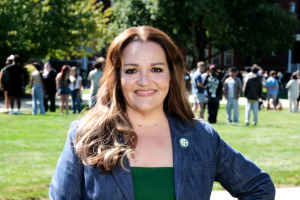
- Fitchburg State President Dr. Donna Hodge named a 2026 WBJ Outstanding Women in Business honoreeFitchburg State University President Dr. Donna Hodge has been selected as one of Worcester Business Journal’s (WBJ) 2026 Outstanding Women in Business honorees. The annual awards program celebrates strong, talented, and remarkable women executives and business leaders who are making a profound mark on the Central Massachusetts economy and community. The awards will be officially presented at the 2026 Outstanding Women in Business Luncheon Ceremony on Wednesday, Oct. 28 at the Hogan Campus Center at the College of the Holy Cross in Worcester. "President Hodge exemplifies the type of visionary, community-minded leadership that moves an institution and a region forward,” said Fitchburg State University Chair of the Board of Trustees Dr. Michael Fiorentino Jr. “The Board of Trustees is thrilled to celebrate this honor with her, and we look forward to continuing our work together as Fitchburg State reaches new heights of academic excellence and economic impact.” Hodge, who became the 12th president —and first female leader —of Fitchburg State in 2024, is being recognized for her visionary leadership, disciplined financial stewardship, and deep commitment to weaving the university into the civic, economic, and cultural fabric of North Central Massachusetts. "I'm honored to be recognized alongside women whose leadership is shaping Central Massachusetts," said Hodge. "Leading a public university requires us to be disciplined with our resources and ambitious about what we can make possible. At Fitchburg State, that means building programs that respond to regional needs, strengthening partnerships with employers and our community, and making sure more students can see a future for themselves here. I'm grateful to the colleagues and partners who share that work with me." Under Hodge’s leadership, Fitchburg State has experienced a resurgence, reversing a decade-long enrollment decline with an incoming class larger than the previous year. Central to this success is the "Fitchburg Promise," a groundbreaking direct-admissions and tuition-free agreement established with five local high schools in Fitchburg to remove barriers to higher education for Fitchburg residents. "I'm delighted that Dr. Hodge has earned this meaningful and well-deserved recognition from the Worcester Business Journal for her continued success advancing the vital mission of Fitchburg State University,” said Vice Chair of the Board of Trustees Eric Gregoire. “Donna's leadership has cultivated a renewed commitment to serving the students of North Central Massachusetts and beyond, while ensuring a vibrant campus culture where all students can thrive. Her vision for the possibility of Fitchburg State demonstrates why she is an outstanding honoree for this award." Hodge has also spearheaded transformative economic development initiatives in downtown Fitchburg, including the revitalization of the historic Theater Block through an alliance with GFI Partners to create mixed-use housing and retail space. Additional key initiatives during her tenure include: Formalizing strategic partnerships with the Applewild School, Fitchburg Public Schools, Workers Credit Union, and the Fitchburg Art Museum. More than doubling the number of military and veteran students and families served by the university. Launching two new varsity sports programs — women’s ice hockey and men’s lacrosse. Establishing the Presidential Ambassadors program to foster leadership pipelines for undergraduate students. Beyond campus, Hodge serves on the boards of the Community Foundation of North Central Massachusetts, the North Central Massachusetts Chamber of Commerce, the Fitchburg Art Museum, and the Girl Scouts of Central and Western Massachusetts. Nationally, she contributes to the Presidents for Latino Student Success Network, the ALL IN Campus Democracy Challenge’s 2026 Presidents’ Council, and the American Association of State Colleges and Universities’ (AASCU) Committee on International Education. To learn more about Dr. Hodge and her fellow honorees, visit the Worcester Business Journal. For more information about the event or to purchase tickets, visit wbjournal.com/event/women-in-business/.


Latest News
- University celebrates Italian American Heritage Month with food and live musicFitchburg State University’s Center for Italian Culture invites the campus community and the general public to celebrate Italian American Heritage Month with an unforgettable evening of music and culinary traditions on Saturday, Oct. 24, in the Falcon Pub in Hammond Hall, 160 Pearl St. Doors open at 5 p.m. with the performance beginning at 7 p.m. The special celebration features smooth-voiced entertainer Jimmy Mazz, a seasoned performer with more than 40 years of experience headlining at premier venues across the country, including the Superstar Theater in Atlantic City. Mazz will bring his dynamic stage presence to campus for a live musical tribute highlighting iconic classics made famous by beloved Italian American artists across generations. Tickets for the event are $50 per person, which includes full access to the performance and catering. Due to venue capacity, seating is strictly limited, and advance registration is strongly encouraged. Guests can reserve their seats today through the university’s online payment portal. For more information go to fitchburgstate.edu/cic In addition to live entertainment, guests will enjoy a curated menu of traditional cicchetti — authentic Italian-style appetizers — specially catered by Fitchburg State’s Dining Services. The event is open to students, faculty, staff, alumni, and local community members. A variety of fine Italian wines and beers will be available for purchase at the Falcon Pub bar for attendees who are 21 and older with valid identification.
- Instrumental and choral ensembles perform Music Mega Mix on Oct. 20The Music Mega-Mix, Fitchburg State University’s showcase of bite-sized performances by its Community Orchestra, Concert Band, Chamber Choir, Concert Choir, Falcon Drumline and Modern Jazz Ensemble will be held at 7 p.m. Tuesday, Oct. 20 in Weston Auditorium, 353 North St. Admission is free and open to the public. The ensembles consist of students, alumni, faculty, staff, and community members. The Community Orchestra is conducted by Professor Hildur Schilling. Associate Professor Jonathan Harvey conducts the Chamber Choir and Concert Choir, and the Concert Band and Modern Band are conducted by Associate Professor Amy McGlothlin. Learn more about the university's music offerings at fitchburgstate.edu/music.
- New major in Finance approved by BHE; program will launch in Spring 2027Fitchburg State University will launch a new bachelor’s degree in finance in 2027, combining rigorous financial and economic theory with hands-on, project-based learning. The new major was approved Tuesday, Sept. 29 by the Massachusetts Board of Higher Education. The new program will prepare graduates for high-earning roles across the financial sector, including market analysis, corporate finance, and financial advising. "This is the kind of academic change that makes me excited about Fitchburg State's future," said University President Donna Hodge. "North Central Massachusetts needs a higher education ecosystem that connects local students to affordable degrees and employers to the talent they need. A finance major strengthens that connection. Our economics and business faculty have built a rigorous, applied program on the courses and expertise already here, making wise use of our resources while giving students a degree with clear value in the Massachusetts economy. I'm grateful to Acting Provost Franca Barricelli, the faculty who developed this major, and the Board of Higher Education for its support. Their work makes Fitchburg State a stronger choice for students and a more responsive partner to our region." The new program, approved by the university’s Board of Trustees earlier this year, will be housed in the university’s Economics, History and Political Science Department, and was developed by faculty in that department in collaboration with the Business Administration Department. Acting Provost and Vice President for Academic Affairs Franca Barricelli said the program’s interdisciplinary foundation will be one of its strengths. "Modern finance demands more than technical fluency — it requires an understanding of how economic policies, political changes, and cultural shifts deeply influence global markets and financial decisions,” she said. “Our curriculum equips students to integrate quantitative thinking with these broader insights, empowering them to act thoughtfully in a rapidly evolving global economy." The 42-credit major will be composed of courses offered in the university’s economics and business programs, along with new courses in investment analysis, financial statement analysis, and corporate finance. The federal Bureau of Labor Statistics predicts that the financial sector will create over 900,000 jobs per year over the next 10-year period, exceeding average industry growth in the U.S. Jobs in the finance sector also tend to be well paid, with the average finance major earning $60,000 with a bachelor's degree directly out of college, according to Glassdoor. “Through hands-on coursework utilizing analysis, experiential learning, and other active learning strategies, our students gain the exact technical and critical-thinking skills demanded by employers,” said Professor Christa Marr of the Economics, History and Political Science Department, and one of the designers of the new major. “Whether they aspire to work in corporate finance, investment analysis, or risk assessment, students will graduate fully prepared to excel from day one.” Professor Andrew Chan of the Business Administration Department said students will benefit from the program’s commitment to support and community connection. “From personalized faculty advising and first-year retention workshops to strategic community partnerships and internships with regional financial institutions, we want every student to feel a true sense of belonging and see a clear, attainable pathway to a successful professional future,” he said. Learn more about the new bachelor’s degree in finance.
- Bill Porter exhibition opens on Oct. 26The Fitchburg State University Humanities Department presents its second exhibition of the academic year, featuring artist Bill Porter. The exhibition, titled “What We Learn to Believe” is on display through December 20 at the Hammond Art Gallery, located in Hammond Hall, 160 Pearl Street. There will be an opening reception at 3:30 p.m. Thursday, Oct. 29 at the gallery. The exhibit starts on Monday, Oct. 26. Admission is free and open to the public. Porter is a research-driven, multidisciplinary artist working primarily in painting, installation, sound, and time-based media. His work critically examines how inherited stories, cultural assumptions, and societal narratives acquire authority and shape our understanding of truth. Drawing heavily from his personal background, Porter brings his Irish immigrant father’s stories of Christianity and rural Donegal into dialogue with the cartoons, comics, and picture books of his American childhood — recontextualizing these familiar materials to explore the space between personal memory and collective belief. As a blind artist with low vision, Porter centers his lived experience and engagement with the broader blind and low vision community to interrogate the cultural construction of disability. His practice challenges the systems that reinforce ableist assumptions, questioning who holds the authority to define accessibility, perception, and narrative. By blending humor with rigorous inquiry, Porter invites audiences to reexamine the stories they inherit, the hidden biases within them, and what they ultimately choose to accept as self-evident.
- Fitchburg State President Dr. Donna Hodge named a 2026 WBJ Outstanding Women in Business honoreeFitchburg State University President Dr. Donna Hodge has been selected as one of Worcester Business Journal’s (WBJ) 2026 Outstanding Women in Business honorees. The annual awards program celebrates strong, talented, and remarkable women executives and business leaders who are making a profound mark on the Central Massachusetts economy and community. The awards will be officially presented at the 2026 Outstanding Women in Business Luncheon Ceremony on Wednesday, Oct. 28 at the Hogan Campus Center at the College of the Holy Cross in Worcester. "President Hodge exemplifies the type of visionary, community-minded leadership that moves an institution and a region forward,” said Fitchburg State University Chair of the Board of Trustees Dr. Michael Fiorentino Jr. “The Board of Trustees is thrilled to celebrate this honor with her, and we look forward to continuing our work together as Fitchburg State reaches new heights of academic excellence and economic impact.” Hodge, who became the 12th president —and first female leader —of Fitchburg State in 2024, is being recognized for her visionary leadership, disciplined financial stewardship, and deep commitment to weaving the university into the civic, economic, and cultural fabric of North Central Massachusetts. "I'm honored to be recognized alongside women whose leadership is shaping Central Massachusetts," said Hodge. "Leading a public university requires us to be disciplined with our resources and ambitious about what we can make possible. At Fitchburg State, that means building programs that respond to regional needs, strengthening partnerships with employers and our community, and making sure more students can see a future for themselves here. I'm grateful to the colleagues and partners who share that work with me." Under Hodge’s leadership, Fitchburg State has experienced a resurgence, reversing a decade-long enrollment decline with an incoming class larger than the previous year. Central to this success is the "Fitchburg Promise," a groundbreaking direct-admissions and tuition-free agreement established with five local high schools in Fitchburg to remove barriers to higher education for Fitchburg residents. "I'm delighted that Dr. Hodge has earned this meaningful and well-deserved recognition from the Worcester Business Journal for her continued success advancing the vital mission of Fitchburg State University,” said Vice Chair of the Board of Trustees Eric Gregoire. “Donna's leadership has cultivated a renewed commitment to serving the students of North Central Massachusetts and beyond, while ensuring a vibrant campus culture where all students can thrive. Her vision for the possibility of Fitchburg State demonstrates why she is an outstanding honoree for this award." Hodge has also spearheaded transformative economic development initiatives in downtown Fitchburg, including the revitalization of the historic Theater Block through an alliance with GFI Partners to create mixed-use housing and retail space. Additional key initiatives during her tenure include: Formalizing strategic partnerships with the Applewild School, Fitchburg Public Schools, Workers Credit Union, and the Fitchburg Art Museum. More than doubling the number of military and veteran students and families served by the university. Launching two new varsity sports programs — women’s ice hockey and men’s lacrosse. Establishing the Presidential Ambassadors program to foster leadership pipelines for undergraduate students. Beyond campus, Hodge serves on the boards of the Community Foundation of North Central Massachusetts, the North Central Massachusetts Chamber of Commerce, the Fitchburg Art Museum, and the Girl Scouts of Central and Western Massachusetts. Nationally, she contributes to the Presidents for Latino Student Success Network, the ALL IN Campus Democracy Challenge’s 2026 Presidents’ Council, and the American Association of State Colleges and Universities’ (AASCU) Committee on International Education. To learn more about Dr. Hodge and her fellow honorees, visit the Worcester Business Journal. For more information about the event or to purchase tickets, visit wbjournal.com/event/women-in-business/.